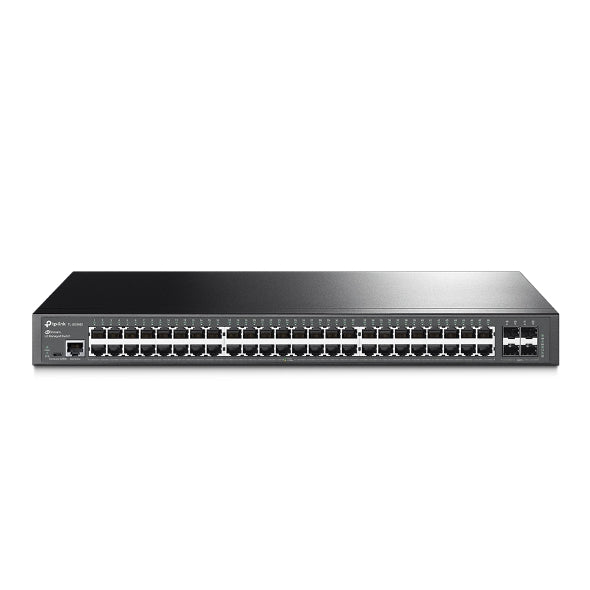
TP-Link SG3452 48-Port Gigabit L2+ Managed Switch
TP-Link SG3452 48-Port Gigabit L2+ Managed Switch
SKU:NWTL-SG3452
The TP-Link SG3452 is a 48-port gigabit managed switch designed for growing business networks. Featuring Omada SDN integration, centralised cloud management, and 4 SFP slots, it delivers robust connectivity and simplified network control for IT teams and distributed organisations.
Couldn't load pickup availability
- See our return policy
- 60 months Manufacturer Warranty
Product Information
| Brand | TP-LINK |
|---|---|
| Category | Network - SMB |
| SKU | NWTL-SG3452 |
| Availability | In Stock |

Overview
- The TP-Link SG3452 is a 48-port gigabit managed switch built for modern business networks that demand both performance and operational simplicity. With 48 gigabit ports and 4 SFP slots, it provides ample high-speed connectivity for growing organisations while maintaining a compact, fanless design suitable for office and data centre environments.
Integration with TP-Link's Omada SDN platform is a standout feature, enabling zero-touch provisioning and centralised cloud-based management across multiple sites. This eliminates manual configuration and allows IT teams to monitor, update, and control the network from a single dashboard—critical for businesses with distributed locations or remote management requirements.
Security and traffic optimisation are built in. The switch supports comprehensive security features including IP-MAC-Port binding, access control lists, DoS defence, and 802.1X authentication. Advanced QoS capabilities ensure voice and video applications receive priority traffic treatment, while IGMP snooping optimises multicast performance. Static routing support further enhances network efficiency for internal traffic management.
With 104 Gbps switching capacity, 77.4 Mpps forwarding rate, and support for 9 KB jumbo frames, the SG3452 handles demanding workloads reliably. The fanless design reduces noise and operational costs, whilst low power consumption (32.8 W) makes it economical to operate continuously. Available management modes—web UI, CLI, SNMP, and RMON—provide flexibility for different network operations teams.
Specifications
| Ports | 48 × 10/100/1000 Mbps RJ45 ports + 4 × Gigabit SFP slots + 1 × RJ45 console port + 1 × Micro-USB console port |
|---|---|
| Switching Capacity | 104 Gbps |
| Packet Forwarding Rate | 77.4 Mpps |
| MAC Address Table | 16 K |
| Jumbo Frame Support | 9 KB |
| Quality of Service | 8 priority queues, 802.1p CoS/DSCP priority, SP/WRR/SP+WRR scheduling, port/flow-based rate limiting |
| Security Features | IP-MAC-Port binding, ACL, port security, DoS defence, storm control, DHCP snooping, 802.1X, RADIUS authentication |
| Management Options | Web interface, CLI (Telnet, SSH), SNMP, RMON, dual image |
| SDN Integration | Omada SDN with zero-touch provisioning and centralised cloud management |
| Power Supply | 100–240 V AC, 50/60 Hz |
| Maximum Power Consumption | 32.8 W (220 V, 50 Hz) |
| Heat Dissipation | 111.91 BTU/h (220 V, 50 Hz) |
| Design | Fanless |
| Mounting | Rack-mountable |
| Dimensions | 440 × 220 × 44 mm (17.3 × 8.7 × 1.7 inches) |
| Warranty | 60 months |
Key Features
Ideal For
FAQs
What is Omada SDN and why does it matter?
Omada SDN is TP-Link's software-defined networking platform that provides centralised cloud-based management of network infrastructure. It simplifies deployment through zero-touch provisioning, allows remote monitoring and control via a single dashboard, and is ideal for organisations managing multiple sites or requiring flexible network administration without on-premises controllers.
Can the SG3452 be used standalone without Omada SDN?
Yes. The switch supports standalone management via web interface, CLI (Telnet/SSH), SNMP, and RMON. This gives flexibility for organisations not yet using Omada SDN or preferring traditional management methods.
What is the difference between the RJ45 ports and SFP slots?
The 48 RJ45 ports support standard twisted-pair cabling for gigabit connectivity up to 100 metres. The 4 SFP slots accept small form-factor pluggable modules for long-distance fibre connections or specialised media, offering flexibility for backbone and uplink requirements.
How does QoS help with voice and video applications?
QoS (Quality of Service) prioritises traffic types using 8 priority queues and intelligent scheduling. This ensures voice calls and video streams receive consistent bandwidth and low latency, whilst lower-priority traffic (email, backups) is throttled if needed, maintaining application performance during peak usage.
Is the fanless design reliable in warm environments?
Yes. The fanless design eliminates moving parts, reducing failure points and maintenance needs. At maximum power consumption of only 32.8 W with 111.91 BTU/h heat dissipation, the switch generates minimal heat. Proper rack ventilation and ambient room conditions ensure reliable operation.
What security features protect the network?
The SG3452 includes IP-MAC-Port binding (prevents spoofing), access control lists (ACL), port security, DoS defence, storm control, DHCP snooping, 802.1X port-based authentication, and RADIUS integration—providing multi-layered protection against unauthorised access and network attacks.
What is static routing and when would we use it?
Static routing allows manual definition of traffic paths between network segments without dynamic routing protocols. This is useful for organisations wanting predictable, controlled internal traffic flow, simplified network topology, or reduced routing overhead in stable network environments.
What warranty and support is provided?
The SG3452 includes a 60-month (5-year) manufacturer warranty. Support availability varies by region and reseller; consult with Hyetech Australia for local support options, firmware updates, and Omada SDN platform assistance.